News

Keep up to date with TNEI’s latest news and opinion pieces

TNEI provide swept path analysis considering 60m and 70m+ turbine blades

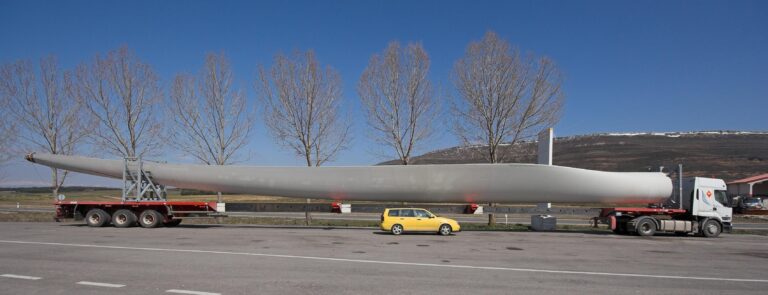
Many onshore wind developments are now looking to deploy larger and larger turbines to ensure they are financially viable in a post subsidy world. Whilst these larger turbines can make the business case appealing, the logistics associated with getting larger wind turbine components to site can be very challenging. Using AutoTrack software we have produced models for a range of turbine blade delivery vehicles, including blades up to 71m long. We have also undertaken site visits to confirm assumptions, highlight weight limits or potential grounding issues. We have found, even with well established turbine delivery routes, that ultimately there is a limit to the length of vehicles that can successfully navigate proposed routes. This can result in either having to place agreements with third party landowners or even limiting blade length. Either way, both have a financial impact on projects that are already under pressure, highlighting the importance of addressing


button

Approval for Peel’s Mossy Hill Scheme

The Mossy Hill Wind Farm near Lerwick on Shetland Mainland received local level approval on Monday 15th April. The approval, for a development of twelve 145m to tip turbines, followed the removal of an objection from SNH relating to impacts on the East Mainland Coast, Shetland proposed Special Protection Area and on regional populations of red throated diver. TNEI coordinated the EIA and managed the design process for the scheme. Our teams also undertook noise, shadow flicker, peat & soils, geology & hydrology, TV & radio-communications and socio-economic impact assessments. If you have a project that could benefit from TNEI’s Environmental Impact Assessment services or would like any further information, please get in touch.

button

Strathclyde graduates join TNEI’s Glasgow office

TNEI is delighted to welcome Max McFarlane and Kevin Dowling as the latest recruits to its growing Glasgow office. Max, an Electronic and Electrical Engineering graduate from the University of Strathclyde, has experience on various data-orientated projects from classifying qualitative hypotheses. He has specialist skills in power system analysis, protection and economics and is able to contextualise and convey the significance of data analytics. His work at TNEI will focus on Mathematical Modelling and Machine Learning approaches within Data Analytics which will involve the implementation of novel network analysis techniques in LV distribution networks, improving DNO investment efficiency with increasing penetration of Low Carbon Technologies and Distributed Generation. Kevin has a degree in Electrical and Mechanical Engineering and also recently graduated from the University of Strathclyde. He has extensive knowledge on power systems from their initial design specifications right through to operation and protection and carried out a feasibility study

button

TNEI Appoints Senior Consultant

We are delighted to welcome Nathaniel Cowton to the TNEI team, who joins us as a Senior Consultant in the Newcastle office. Nathaniel brings extensive experience of HVDC projects, having worked on every stage of the project lifecycle for such schemes and across both cables and converter stations. Nathaniel enjoys engaging with a wide range of stakeholders to develop and deliver projects and has a strong understanding of the consenting process and the commercial environment in which developers and asset owners operate. He has a particular interest in regulatory and policy matters and was previously a Senior Policy Advisor to the National Infrastructure Commission, where he contributed to the UK’s first ever National Infrastructure Assessment, focussing particularly on the Contracts for Difference (CfD) regime. Nathaniel will be presenting at the IET ACDC Power Transmission Conference this week. If you are attending, don’t miss his presentation “‘The changing landscape of Great

button

TNEI delivers G99 training as part of 2019 training programme

Last month TNEI’s experienced consultants Jonathan and Ali delivered an in-depth training session to industry professionals on the new Engineering Recommendation (EREC) G99. EREC G99 was issued in July 2018 by the Energy Networks Association (ENA) following the assimilation of the EU Commission Regulation on harmonising network standards into GB Distribution and Grid Codes. It has been written to comply fully with RfG as well as including other requirements for connecting into the GB Power System. G99 sets out a system of generator classification, based on rated export capacity (in MWs) and connection voltage, and defines generator configurations either as power generating modules or as power generating facilities. The manner in which technical compliance requirements are applied and demonstrated depending on these issues is also explored within this document. The new G99 application form should be used for all applications where the date of connection is on or after 27

button

Grid Connections for Scottish Renewable Generators

In Scotland, onshore wind remains the predominant generation type, making up approximately 59% of registered grid scale generation. An increasing number of developers believe that subsidy-free wind projects are feasible, thus the trend in onshore wind generation growth is likely to continue. Other renewable technologies are seeing an uptake in interest including offshore wind (Crown Estate Scotland’s upcoming ScotWind Leasing round), the developing marine energy sector and a somewhat surprising growth in large scale Solar PV. There is concern about the ability of existing transmission infrastructure in Scotland to facilitate the scale of connections required to cater for this growth. The, now operational, Moray Firth ““ Caithness HVDC link, while providing a route for power from wind farms in the north of Scotland to flow south, hasn’t helped in resolving the well documented bottleneck between Scotland and England. The planned Peterhead ““ Drax link and onshore reinforcements, such as the

button

To download the report, please enter your email address:

To view the videos please enter a valid email address: