News

Keep up to date with TNEI’s latest news and opinion pieces

TNEI welcomes new member to its Networks and Innovation team

Specialist independent energy consultancy, TNEI is delighted to welcome Dr Gruffudd Edwards to its Glasgow office. With an academic background spanning statistics, electrical engineering and physics, his research has often bridged these disciplines, including a PhD on the development of time series models capable of reproducing the dynamics of wind resource availability on multiple spatial and temporal scales. Gruffudd has professional experience in mining, analysing, interpreting, predicting and visualising data and has strong expertise in stochastic power system modelling and the application of operational research methods to power system problems. His most significant projects include assessing the maximum contribution of multiple storage plant to the security of supply in the future GB power systemand assessing the potential value of large wind projects to the security of supply in Kenya and Ghana. He also validated National Grid’s representation of wind generation in their capacity adequacy outlook reporting. Gruffudd’s main areas of

button

Extending Competition in Onshore Electricity Transmission

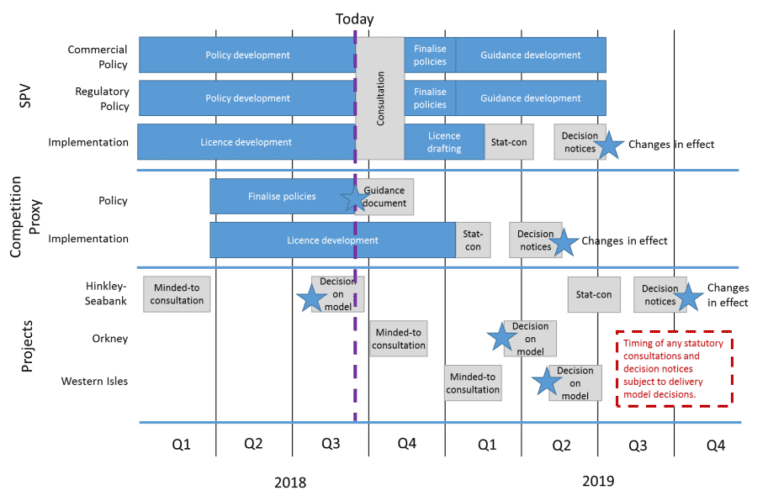
On 14thSeptember, Ofgem published a letter providing an update on the arrangements to extend competition in onshore electricity transmission.Previously, in June 2017Ofgem published an update stating that the CATO (Competitively Appointed Transmission Owner Regime) would be deferred. However, the Hinkley Seabank consultation, published in August 2017, included two alternative possible models for the introduction of competition. (TNEI provided technical support to Ofgem for the Final Needs Case for Hinkley Seabank.) Special Purpose Vehicle (SPV) Model:an SPV would be created which would finance, construct and operate the transmission asset under the terms of a contractual arrangement with the TO (i.e. NGET in the case of Hinkley Seabank).Unlike in the CATO model, NGET would retain the regulatory responsibility for delivering the project and the operation control of the assets. Competition Proxy Model (CPM):Ofgem would set allowed revenues for the reinforcement that they consider would have resulted from an efficient competition for construction,

button

Auction Trial for Frequency Response

On 31st Augustthis year, National Grid published a Letter to the Industryto outline the process for the Auction Trial for Frequency Response, and hosted a webinar on 27thSeptember to provide further details. The auction itself will have the following characteristics: The auction will be held every Friday morning and results will be published by early afternoon. The first available delivery window will start at 23:00 on the same day. Four products will be procured: high and low frequency dynamic response, and high and low frequency static response. The products will be auctioned by four-hourly Electricity Forward Agreement (EFA) blocks over the week. Buy orders will be published prior to the auction, and will consist of information on volume requirements to be procured for the following week. Bids will be accepted in price order without regard to the volume offered to reduce complexity and improve transparency. Providers will have the ability

button

Contracts for Difference: the TNEI Perspective

On 23rdJuly 2018, the Department for Business, Energy and Industrial Strategy (BEIS) announced that the next auction round for the allocation of Contracts for Difference (CfD) for eligible renewable energy generation will open in May 2019. In addition, BEIS announced that further allocation rounds will be held every two years starting from 2021. With £176 million allocated during the second allocation round (in 2017), and £557 million in committed funding remaining, it can reasonably be expected that there will be auctions in 2019, 2021, 2023 and (potentially) 2025. What is a Contract for Difference? A CfD is a private law contract between a low carbon electricity generator and the Low Carbon Contracts Company. A CfD gives a generator greater certainty and stability of revenues by reducing their exposure to volatile wholesale prices and protecting consumers from paying for higher support costs when electricity prices are high. CfDs ““ What will

button

TNEI Completes Environmental Impact Assessment for Mossy Hill Wind Farm on Shetland

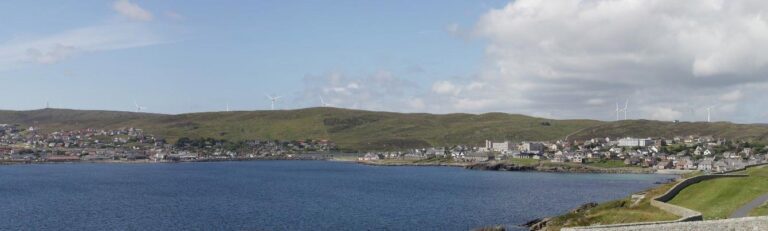
Peel Wind Farms (No1) Ltd has submitted the Environmental Statement and accompanying reporting to Shetland Island Council forming its application to install and operate a wind farm between Lerwick and Scalloway on Shetland Mainland. The proposal is for 12 wind turbines with an overall generating capacity of up to 50MW. TNEI coordinated the EIA and scheme design processes and provided a range of specialist inputs including assessments of: “¢ Construction and operational noise; “¢ Peat and carbon soils; “¢ Carbon balance; “¢ Socio-economics and tourism impacts; “¢ Shadow flicker; “¢ Hydrology and ground conditions; and “¢ In-combination effects. The project enabled us to bring to bear over 60 years of combined specialist wind energy experience across our EIA, acoustics and civil engineering teams. A careful iterative design process saw the scheme evolve from the initial 21 turbine proposal, that was the basis for the EIA Scoping process, to the submitted

button

SNH Repowering Guidance; It’s All About The Baseline

The recent Scottish Natural Heritage (SNH) draft guidance on wind farm repowering, published in June 2018, is out for consultation until 31st August. Jason McGray, TNEI’s environment and consents lead, sets out his thoughts on the approach to assessment that is proposed and implications for commercial scale wind farms. The draft guidance specifically focuses on repowering existing operational wind farms. It does not cover life extension or increasing the design envelope of consented but unbuilt schemes. SNH naturally focuses on its areas of responsibility; landscape and ecology, although the document is likely to provide guidance on the approach to assessment that could be adopted by other topic areas. While the guidance will apply only to Scotland, it is likely that, in the absence of anything similar, the determining authorities in England, Wales and Ireland would look to it as has been the case with previous guidance, such as for production

button

To download the report, please enter your email address:

To view the videos please enter a valid email address: