News

Keep up to date with TNEI’s latest news and opinion pieces

Increased grid costs for generators a Targeted Charging Review (TCR)

Ofgem are proposing to change the structure of Use of System (UoS) charges; the process that governs the allocation of charges to network uses. These charges cover the cost of operating and maintaining the electricity network. These charges ““ levied according to size, connection voltage, and user location ““ also pay for a range of other activities undertaken by the system operator, distribution network operators, and transmission owners. Currently, a portion of these charges are disbursed as payments to certain network users and are referred to as Embedded Benefits. The proposed changes were published in Ofgem’s recent Targeted Charging Review (TCR) public consultation. The proposed changes could have a significant impact on a project’s financial model, specifically to operating expenditure on annual grid connection charges for operational generators. It is a distinct possibility that, on average, UoS charges will increase for most generators as a result of these proposals and

button

The dos and don’ts of data science for smart power networks

We live in an era of data, where the sheer amount being captured and stored in all areas of life is exploding. With that, as the challenges faced across all industries grow in both number and complexity, so does the requirement for increasingly sophisticated use of this data. The electrical power sector is no exception, with the types of data that are likely to be available in much greater amounts, particularly at the lowest voltage levels, includes more granular network monitoring, weather monitoring and the smart metering of individual customers (subject to privacy rules). This data will surely be an immense resource in embracing the challenge of delivering a low-carbon, secure and affordable energy system with pro-active consumers. TNEI believes that, in order to realise the potential benefits of this data, the power sector must embrace the field of data science while ensuring that the analysis conducted follows good practice

button

National Grid Power Outage Report Published

Ofgem has published the Technical Report on the events of 9 August 2019 with technical appendices covering responses from the affected parties. This can be viewed by following the link: https://www.ofgem.gov.uk/publications-and-updates/investigation-9-august-2019-power-outage This was updated on the 10th September 2019 and forms part of the formal investigation into the power cuts experienced on 9th August 2019. The report points to a lightning strike on the Eaton Socon-Wymondley double circuit, shortly followed by the loss of c.500MW of embedded generation due to their Loss of Mains Protection. Following the lightning strike Hornsea offshore wind farm de-loaded 737MW and Little Barford CCGT tripped with a loss of 641MW. In little over a minute the system frequency dropped to critical levels triggering the Low Frequency Demand Disconnection (LFDD) operation, 931MW of demand was disconnected from the system by DNOs. No more than 4 minutes later the system frequency was restored to 50Hz and stabilised

button

Uncertainty in the Capacity Market

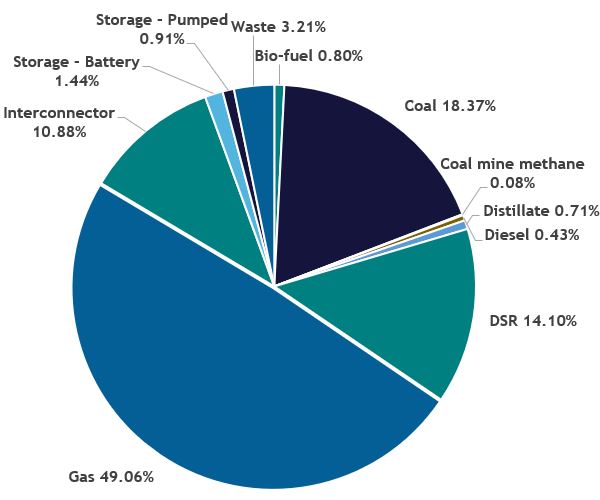
The Capacity Market is still in its suspended state after the landmark ruling in November 2018 by the European Court of Justice following the legal challenge by Tempus Energy. The European Court of Justice ruled that the European Commission had incorrectly granted the Capacity Market state aid approval. Earlier this month, Tempus lodged evidence with the European Commission to substantiate its claim that the Capacity Market unfairly discriminates against clean energy projects. Tempus escalated its case to the High Court in March 2019 after BEIS made a series of decisions which they say amounted to an unlawful attempt to keep the mechanism in place. Tempus’ High Court hearing starts in November. The UK Government hopes to reinstate the market late 2019 / early 2020. In the hope that the market is reinstated quickly, BEIS has instructed the EMR Delivery Body, National Grid Electricity System Operator (NGESO)that their preference is to

button

Decision Pending on Ofgem Energy Storage Consultation

One of the cost barriers to the further development of energy storage technology in the GB market has been the confusion about its classification or rather its lack of classification. Not defined in the Electricity Act of 1989 or subsequent primary legislation, energy storage has, as a result, directly suffered in comparison to generation and other more traditional network infrastructure, most obviously when it comes to the use of system charging. Most grid connected energy storage projects contract with network operators for equivalent export and import capacities, meaning that they pay higher demand use of system charges than most generators, and higher generation use of system charges than most demand customers, and are “double charged” for each unit of energy transported across the network unlike other users. Ofgem are seeking to address this issue, amongst others, in their push to inject flexibility into the energy system and transform it into

button

Recent National Grid Future Energy Scenarios Publication

The recent Future Energy Scenarios (FES) published by National Grid Electricity System Operator (NGESO) has reaffirmed its scenario framework to help support the transition towards the 80% carbon emission reduction target of 2050. A new addition to the report is the sensitivity model, which coincides with the government’s proposed shift towards a net zero carbon emission energy network. Focusing on the trends of decarbonization and decentralization, the report identifies four key scenarios which can help achieve the current 80% reduction target. The 2050 target is evaluated for each scenario to determine whether or not the target can be achieved, as well as the rate at which the goal could be achieved. The evaluation is based on developments within the past year, including; policy support, consumer engagement, economic growth, technology development and energy efficiency, and how they have helped boost each scenario’s forecast outcomes. The scenarios “‘Community Renewables’ and “‘Two Degrees’

button

To download the report, please enter your email address:

To view the videos please enter a valid email address: