News

Keep up to date with TNEI’s latest news and opinion pieces

Recent National Grid Future Energy Scenarios Publication

The recent Future Energy Scenarios (FES) published by National Grid Electricity System Operator (NGESO) has reaffirmed its scenario framework to help support the transition towards the 80% carbon emission reduction target of 2050. A new addition to the report is the sensitivity model, which coincides with the government’s proposed shift towards a net zero carbon emission energy network. Focusing on the trends of decarbonization and decentralization, the report identifies four key scenarios which can help achieve the current 80% reduction target. The 2050 target is evaluated for each scenario to determine whether or not the target can be achieved, as well as the rate at which the goal could be achieved. The evaluation is based on developments within the past year, including; policy support, consumer engagement, economic growth, technology development and energy efficiency, and how they have helped boost each scenario’s forecast outcomes. The scenarios “‘Community Renewables’ and “‘Two Degrees’

button

Updates to Targeted Charging Review

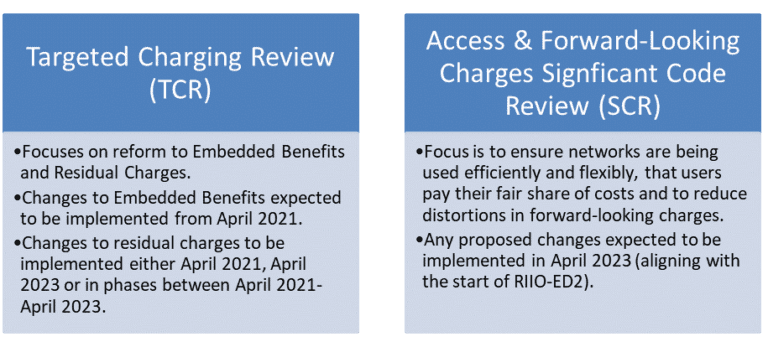
Following the publication of their Minded-To position in November 2018, Ofgem published a further consultation on the Targeted Charging Review (TCR) to get feedback on their refined residual charging banding proposal. This second consultation is open until 25th September 2019. TCR and SCR.png Out of the two options identified for residual charges, Ofgem prefer a Fixed Residual Charge, where the total allowed residual revenue will be apportioned per voltage level, then into user segments within that voltage level. Ofgem also released the first of two SCR Working Papers this year, setting out their current thinking for potential options under the scope of the SCR. The main focus of this paper was network access options and options for network charges (including design options for charges and improving location accuracy of distribution charges). The key options for further consideration for access are firmness, time-profiled rights, and shared access rights. Other options will

button

Bringing down the average age of the Newcastle office (briefly)

TNEI hosted four Durham University students in the Newcastle office last week to work on two mini projects, including one which expanded on some shadow flicker work TNEI had previously carried out on quantifying the density of shadows, putting it into context on the available literature on human response. Shadow flicker from proposed wind farm developments can be accurately predicted using specialist software. Whilst, in theory, shadows can be cast great distances from turbines the intensity of the shadows does decrease with distance. Accordingly, guidance in the UK and Ireland is based on the assumption that, normally, shadow flicker occurring at distances greater that 10 Rotor Diameters (RD) away from the turbine(s) is negligible. The study carried out by students Lewis and Thomas used available literature and site data to analyse the validity of the 10 RD study area. Their project involved calculation of shadow density (the percentage of the

button

EREC G99 and EREC G59: What are the differences and what does it mean for your generator?

Are you developing a grid connected generation project rated at 50kW or above? Engineering Recommendation (EREC) G99 applies to you! EREC G99 was issued in July 2018, by the Energy Networks Association (ENA), following the assimilation of the EU Commission Regulation on harmonising network standards, known as Requirements for Generators (RfG), into GB Distribution and Grid Codes. It has been written to comply fully with RfG as well as including other requirements for connecting into the GB Power System. It encompasses and replaces the long serving EREC G59 with changes to the application process, compliance requirements and commissioning requirements. G99 generators will need to be aware of the new process and requirements. With regards to the connection application form, the ENA states that; Whilst the old G59 application form may be used for connection applications where the connection is required before 27 April 2019, the new G99 Standard Application Form

button

Valuing flexibility: uncertainty, risk and regret

All of Great Britain’s Distribution Network Operators (DNOs) are taking actions to access greater load flexibility on their networks. Together, they have committed to testing the market for flexibility services as a means of managing network constraints[1], and have published six key steps for achieving this[2]. Use of flexibility services could mean increased real-time (or close to real-time) coordination, operation and optimisation of the network, which will require improvements in dispatch capability, forecasting, and management of operational risk. A robust approach to managing risk will be key for ensuring flexibility requirements can be quantified, procured and managed efficiently, and its value can thus be released. Uncertainty about both the long-term and short-term evolution of the energy system is likely to be a key source of risk for DNOs. There are big questions about, for example, the extent and pace of decarbonisation, which industry is increasingly exploring through the use of

button

Good news for wind farm Life Extension Schemes: Consent granted for first Life Extension project of its kind

A significant number of wind farms and wind turbines will reach the end of their service life in the near future. There are three main options once wind farms reach the end of their planning consent: Repowering, Decommission or Life Extension. The latter has become less problematic due to the clarity provided in the Kirkby Moor Wind Farm “‘Life Extension’ project that was granted consent last week following a Public Inquiry. TNEI provided noise evidence for the appellant during the Inquiry. Kirkby Moor Life Extension Project This 12-turbine scheme was originally consented in 1992 with a requirement within the permission to remove the turbines after 25 years operation. The consent expired and the appellant sought to extend the life of the wind farm until March 2027 by varying the relevant planning condition. The appeal decision is particularly important in England where footnote 49 of the National Planning Policy Framework (NPPF)

button

To download the report, please enter your email address:

To view the videos please enter a valid email address: