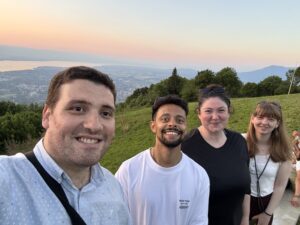
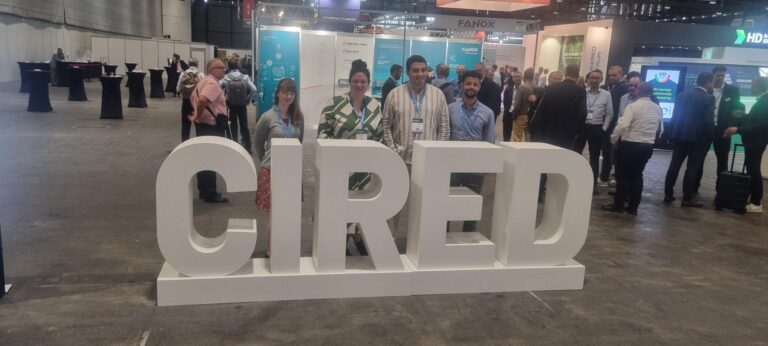
Sarah Sheehy, Rosemary Tawn, Mohamed Galeela and Nathanael Sims recently attended CIRED 2025 in Geneva bringing together contributors from across the globe, including utilities, manufacturers, academia, and innovators, to share insights and advancements in the planning and operation of distribution networks.
The event offered a packed programme of presentations, poster sessions, and roundtables covering six core themes: network components; power quality and safety; operation; protection, control and automation; distribution system planning; and the evolving role of customers and regulation.
Topics ranged from the integration of inverter-based resources and flexibility markets, to challenges in cyber security, data driven asset management, and evolving regulatory frameworks for DSOs.
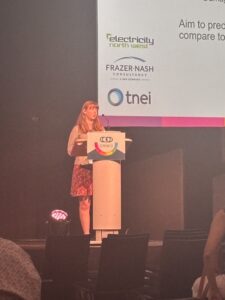
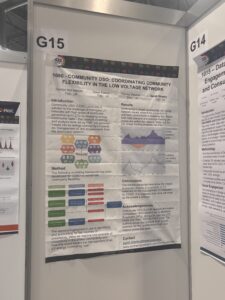
TNEI made several active contributions to the conference. Sarah Sheehy presented work from the ongoing Community DSO project with Northern Powergrid, which focuses on coordinating flexibility from local energy communities to manage low voltage network constraints.
The approach combines real GIS-based network modelling with a flexibility coordinator to assess how “cells” within the network can respond under uncertainty, including challenges like phase imbalance and incomplete data.
Rosemary Tawn presented developments in probabilistic modelling of LV cable degradation, developed in collaboration with Frazer-Nash and Electricity North West.
The work combines physical simulations of thermal stress with statistical models to predict fault risk at cable joints and improve asset management.
Both contributions were well received and highlighted the growing need for data-informed, proactive approaches to LV network operation and planning.
Power quality emerged as a particularly prominent and widely discussed theme throughout the week, with international examples from Korea, the US, and across Europe underlining how issues such as harmonics and voltage disturbances are becoming more prevalent and complex in modern, power-electronics-dominated grids.
There were clear calls for more coordinated approaches to standard setting, improved modelling techniques, and smarter planning to alleviate power quality-related delays in new connections.
As always, CIRED proved to be a good opportunity to engage with a wide network of peers, share perspectives, and learn and exchange knowledge on the evolving challenges facing electricity networks worldwide.
We look forward to returning for CIRED 2027!