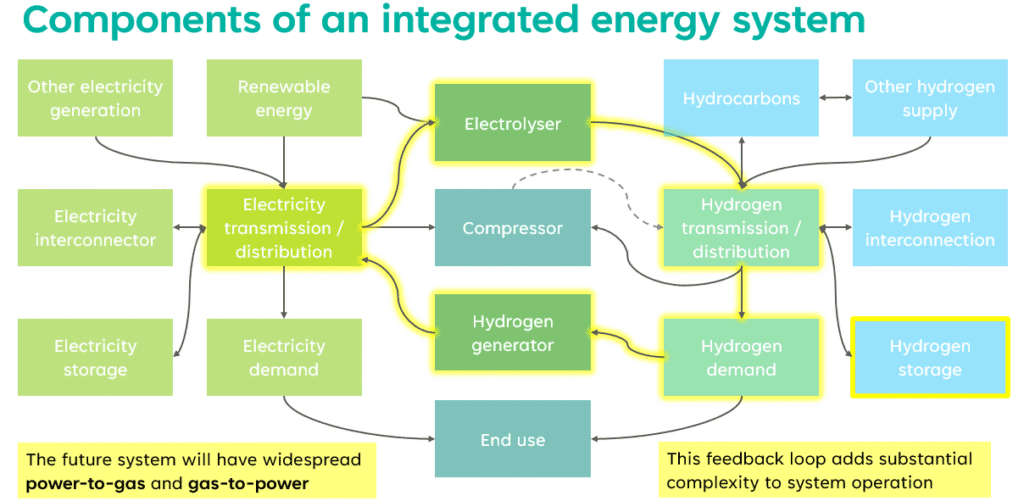
In future energy systems, the optimal operation of integrated energy networks – electrical, blended natural gas and hydrogen, pure hydrogen and heat – will require much greater coordination between them, including through storage import and export decisions and power to gas (P2G) plant actions. The feedback loop created by the widespread power-to-gas and gas-to-power will add substantial complexity to system operation.
Many current power-to-gas models adopt certain simplifications to remain manageable. These often involve using broader time or location scales, assuming predictable outcomes, and modelling markets in an idealised way.
But these trade-offs come at a cost. They risk underestimating the complexity of operating integrated energy systems, the assets required, and the investment needed.
For example, models may ignore short-term forecast errors, assume perfect foresight, or drop critical constraints like total energy budgets.
This can lead to inefficient infrastructure planning and operational decisions that compromise energy security or inflate consumer costs.
The Future Operability of Gas for System Integration (FOGSI) project aims to shift this balance—towards realism and granularity—to better support investment planning, operational strategy, and policy development.
Funded by the Strategic Innovation Fund (SIF), this Alpha phase project aims to develop an integrated hierarchical network modelling framework, which will simulate future Great Britain (GB) energy system scenarios, where gas and electricity networks are highly interconnected.
The focus will be on realistically modelling the behaviour of power-to-gas and storage operators. These models will be demonstrated as real-time digital twins, to help understand how the system behaves under different conditions.
This is a fresh approach that brings together several sub-fields to test under fully realistic conditions.
The project will run for six months, concluding in January 2026. During this time, a proof-of-concept model will be delivered to help lay the groundwork for a follow-up Beta demonstration phase.
TNEI is delighted to collaborate on this project led by National Gas, and supported by the University of Edinburgh, Energy Systems Catapult, and National Grid Electricity Transmission.