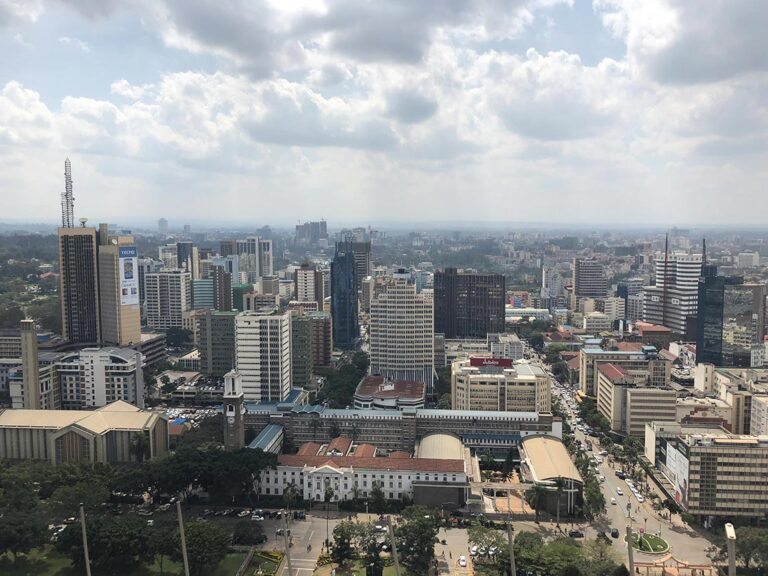
East Africa has a wide ranging and complex mix of energy issues, including lack of access to services and high electricity prices. As an independent specialist consultancy with a base in South Africa, TNEI is well placed to offer expert solutions to improve the energy systems of the region. Recently, our African co-leads, Johan Smith and Etienne Du Preez from our Cape Town office, organised an exploratory trip in order to find out more about the region’s energy mix and expand our African business footprint to include countries in East Africa.
The trip was planned around a solar exhibition in Nairobi, Kenya, and in order to maximise the potential for meetings, we also decided to visit Dar es Salaam (Tanzania) and Kigali (Rwanda).
We landed first in Dar es Salaam, which looked like a tropical island from above, as we were able to see the sea bed. We met with a mini-grid developer who finances, builds and operates mini-grids in remote areas of Tanzania. It was interesting to see the actual overhead conductors and wooden poles lying in the yard, bringing the idea of a mini-grid to life. We then travelled on to Nairobi.

After being in Kenya for three days and having had discussions with various contractors, consultants and developers, we came to the conclusion that things are definitely heating up in Kenya from a renewable energy perspective. We could really feel the energy when walking into the boardrooms of these companies, which indicates things are about to really take off in Kenya.
Most of the major renewable developers have set up offices in Nairobi and have projects in various stages of development. Whilst meeting with potential clients face to face gave us the opportunity to explain the services we can offer, it also allowed us to gather valuable information regarding the direction the country is taking in terms of renewable energy technologies. It was easy to see where TNEI could offer support in terms of capacity assessments or more detailed stability studies in order to identify any network constraints. The tariff discussion came up multiple times and it seems like there is real uncertainty, with the off takers revising their offer to purchase the power on a regular basis, which gives developers grey hair from a financial viability point of view.
We also met with design consultants performing substation and transmission line designs. We had good discussions with them and they were interested in being able to provide a wider service offering to their clients through support that TNEI offers, such as specialist power system modelling and model development services, as well as static and dynamic analysis.
From Kenya we moved on to Rwanda, which was such an interesting country. The people are very friendly and they are very proud of Kigali, which did not seem like the city of a developing country. We met with a hydro developer and could see how our specialist energy consultancy services could fit in to improve practices. With small hydro being a feasible option in the country, it is imperative to study the network infrastructure needed to integrate new hydro stations. There is a lack of engineering training in Rwanda and the government there is supporting initiatives to improve this. TNEI offers theoretical power system and software application training, which can be delivered locally or remotely, thus meeting client needs and budgetary constraints.

Being given the opportunity to experience these countries and their cultures first hand was an absolute eye opener for us. East Africa has great potential to elevate its energy infrastructure through renewable technologies and this fits perfectly with TNEI’s consultancy services, which are designed to guide clients through projects from concept to delivery.
To find out more about our work in Africa or to discuss a project requirement, please contact our TNEI Africa team on +27(0)21 974 6181 or email us.
The views expressed in this article are the authors’ own.