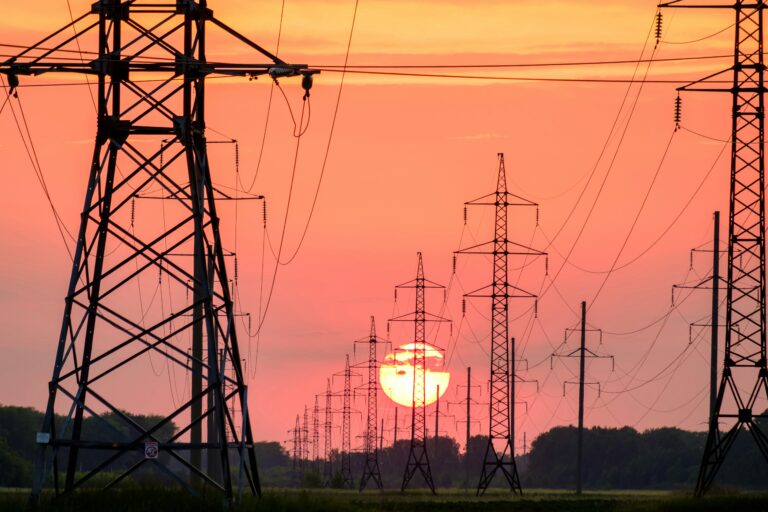
As the energy transition accelerates, electricity networks are being asked to do more than ever before. They must accommodate growing volumes of renewable generation, support the electrification of heat and transport, remain resilient to increasingly extreme weather and maintain stability in a system with fewer traditional sources of inertia.
At CIGRE 2026, TNEI has been presenting six authored and co-authored papers exploring these challenges from multiple perspectives, spanning transmission and distribution networks, system planning, network operation, climate resilience and future power system stability.
Together, the papers provide a snapshot of some of the most important questions facing network owners, system operators, policymakers and more as they plan for the decades ahead:
- How do we understand the combined impact of multiple climate hazards?
- How can network operators best use future climate scenarios?
- How do we maintain stability in future low-inertia power systems?
- How will reactive power behaviour change as distribution networks evolve?
- How can community flexibility support the distribution network?
- How can operators maintain visibility in increasingly active distribution networks?
How do we understand the combined impact of multiple climate hazards?
Infrastructure is rarely exposed to a single risk in isolation.
Extreme heat, ageing assets, storms and changing operational conditions can interact in ways that are difficult to assess using traditional approaches. Our first paper introduces a new methodology for modelling these compound risks through a probabilistic multi-hazard framework.
Using overhead line conductors as an example, the research explores the interaction between temperature-driven ageing mechanisms and windstorm loading, demonstrating how climate-related hazards can be assessed collectively rather than independently. While the specific case study suggests limited additional failure risk from climate-driven temperature increases alone, the methodology provides a powerful framework for assessing future resilience risks in a changing climate.
This work forms part of the Electricity Transmission Heat Effects, Resilience Measures to Manage Asset Lifecycles (THERMAL) project, an innovation programme exploring how climate change may affect transmission assets and what measures network owners can take to improve long-term resilience. More information about the THERMAL project is available here.
Paper: Failure modelling of overhead lines exposed to worsening gradual and instantaneous weather hazards due to climate change
Authors: Aisha Ali (National Grid), Gordon Wilson (National Grid), Dr Gruffudd Edwards (TNEI), Dr Mohamed Galeela (TNEI) and Oscar Hlustik (TNEI)
How can network operators best use future climate scenarios?
Climate resilience is moving from a long-term consideration to an immediate planning challenge.
Co-authored in support of the University of Edinburgh, our second paper from the THERMAL project examines how climate datasets can be used more effectively to support overhead line resilience assessments.
While temperature thresholds are frequently used when assessing future climate impacts, our research shows that the most extreme temperatures are often increasing faster than average temperatures, highlighting the importance of focusing on asset-specific climate risks rather than broad climate indicators.
The work also demonstrates how climate projections, physical asset modelling and interactive visualisation tools can be combined to support more informed resilience planning, helping network owners better understand how future climate conditions may affect long-life infrastructure.
Both this paper and the previous paper form part of the THERMAL innovation project. More information is available here.
Paper: Climate data for overhead line resilience to extreme events
Authors: Chris Dent (University of Edinburgh), James Mollard (University of Edinburgh), Dr Gruffudd Edwards (TNEI), Aninda Bhattacharya (University of Edinburgh), Claire Turle (Frazer-Nash Consultancy), Gabi Hegerl (University of Edinburgh) and Gordon Wilson (National Grid Electricity)
How do we maintain stability in future low-inertia power systems?
As power systems become increasingly dominated by renewable generation and power electronics, maintaining frequency stability becomes more challenging.
This paper explores how multi-terminal high-voltage direct current (HVDC) networks, grid-forming converters and offshore wind farms can work together to provide coordinated frequency support during disturbances. The proposed approach dynamically allocates support across available resources, improving frequency performance while maintaining stable HVDC operation.
The work demonstrates how future HVDC networks could become active contributors to system stability, helping operators manage increasingly renewable-dominated electricity systems.
Paper: Coordinated frequency support in multi-terminal HVDC networks via grid-forming converters with Dynamic Power Allocation
Authors: Akansha Garg (TNEI), IngZhe Wong (TNEI), Jun Liang (Cardiff University), Mohamed Galeela (TNEI), Muhammad Fawad (TNEI) and Yueqi Wu (TNEI)
How will reactive power behaviour change as distribution networks evolve?
Reactive power management is becoming increasingly important to both secure operation and long-term network planning, with many locations in Great Britain now experiencing sustained periods of reactive power export towards the transmission system rather than import.
Our research combines physics-based network modelling with statistical techniques to project future reactive power demand under different demand growth scenarios.
Paper: Reactive power demand projection from distribution networks in Great Britain
Authors: Gordon McFadzean (TNEI), Nathanael Sims (TNEI) and Rosemary Tawn (TNEI)
How can community flexibility support the distribution network?
Flexibility is expected to play a crucial role in enabling decarbonization while minimizing network reinforcement costs.
Our Community Distribution System Operator (DSO) research explores how energy communities can coordinate flexibility at the lowest levels of the distribution network. Rather than relying solely on customers responding individually to market signals, the concept coordinates flexibility around local network needs.
The results show that coordinated community flexibility can outperform conventional time-of-use tariff responses when it comes to reducing local network peaks and managing constraints.
To find out more, view a summary of the project as well as project reports.
Paper: Community DSO: Assessing the impact of coordinated flexibility from energy communities
Authors: Harvey Dawson (TNEI), Owen Patrick (TNEI), Gordon McFadzean (TNEI) and Sarah Sheehy (TNEI)
How can operators maintain visibility in increasingly active distribution networks?
Distribution networks are becoming more complex as distributed energy resources, flexible demand and low-carbon technologies continue to grow.
Maintaining visibility of network conditions is therefore becoming increasingly important for network operators. Our final paper advances both steady-state and dynamic state estimation techniques for modern distribution systems using a Modified Augmented Nodal Analysis (MANA) framework.
The research introduces new approaches to improve estimation accuracy when measurements are sparse, while also providing scalable dynamic state estimation techniques capable of supporting increasingly active and data-rich distribution networks. The result is a toolkit that can help operators improve real-time situational awareness and make more informed operational decisions.
Paper: Advancements in static and dynamic state estimation techniques for modern distribution systems
Authors: Firduous ul Nazir (Glasgow Caledonian University), IngZhe Wong (TNEI), Mohamed Galeela (TNEI) and Zahid Javid (TNEI)
Meet the TNEI team at CIGRE 2026
TNEI has been presenting six papers across a range of technical sessions covering climate resilience, active distribution systems, system planning, flexibility and future network operation. If you’re attending CIGRE 2026 in Paris, we’d be delighted to discuss our research and answer any questions.