On 14thSeptember, Ofgem published a letter providing an update on the arrangements to extend competition in onshore electricity transmission.Previously, in June 2017Ofgem published an update stating that the CATO (Competitively Appointed Transmission Owner Regime) would be deferred.
However, the Hinkley Seabank consultation, published in August 2017, included two alternative possible models for the introduction of competition. (TNEI provided technical support to Ofgem for the Final Needs Case for Hinkley Seabank.)
- Special Purpose Vehicle (SPV) Model:an SPV would be created which would finance, construct and operate the transmission asset under the terms of a contractual arrangement with the TO (i.e. NGET in the case of Hinkley Seabank).Unlike in the CATO model, NGET would retain the regulatory responsibility for delivering the project and the operation control of the assets.
- Competition Proxy Model (CPM):Ofgem would set allowed revenues for the reinforcement that they consider would have resulted from an efficient competition for construction, financing and operation of the reinforcement.This is considered a proxy model, and would not require a full competitive process, as would be needed for the CATO or SPV models.Instead, benchmarks would be used from fully competitive sectors such as OFTOs to set the rates.
The CPM model has already been agreed to be implemented for the Hinkley Seabank project.This update includes: a consultation on the SPV model;an update on CPM; andan Impact Assessment setting out the benefits and costs of the SPV and CPM models, as summarised below.
|
Summary of Options |
Main Effects on Consumer Outcomes |
Key Considerations |
|
Option 1: Existing Strategic Wider Works arrangements |
No change to current outcomes. |
Represents the counterfactual of delivery through the prevailing price control by the relevant incumbent TO. |
|
Option 2: SPV model |
Possible consumer saving of 13-18.7% if implemented efficiently. |
The option introduces potential consumer cost risk over use of COPM if not implemented efficiently by the TO |
|
Option 3: CPM |
Possible saving of 10.9 “ 12.1%. |
Extent of savings for consumer depend on difference between the cost of capital for the project via CPM and the prevailing cost of capital via the price control for SWW. |
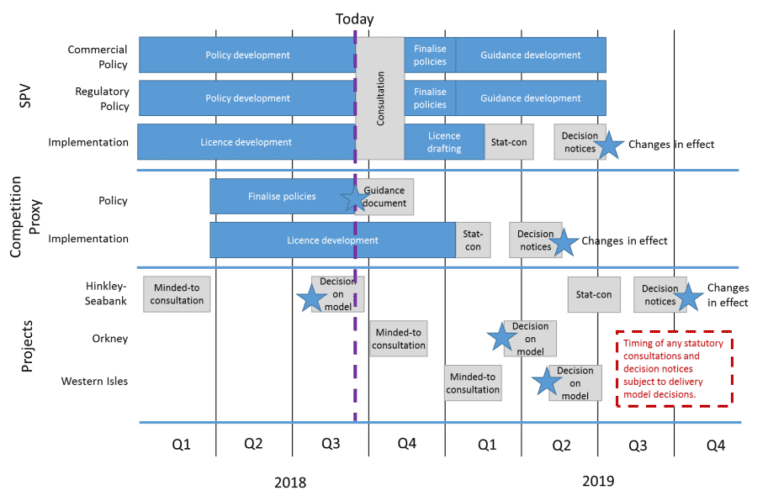
The timeline for implementation of the delivery model to Hinkley Seabank, Orkney and Western Isles has been published by Ofgem below: